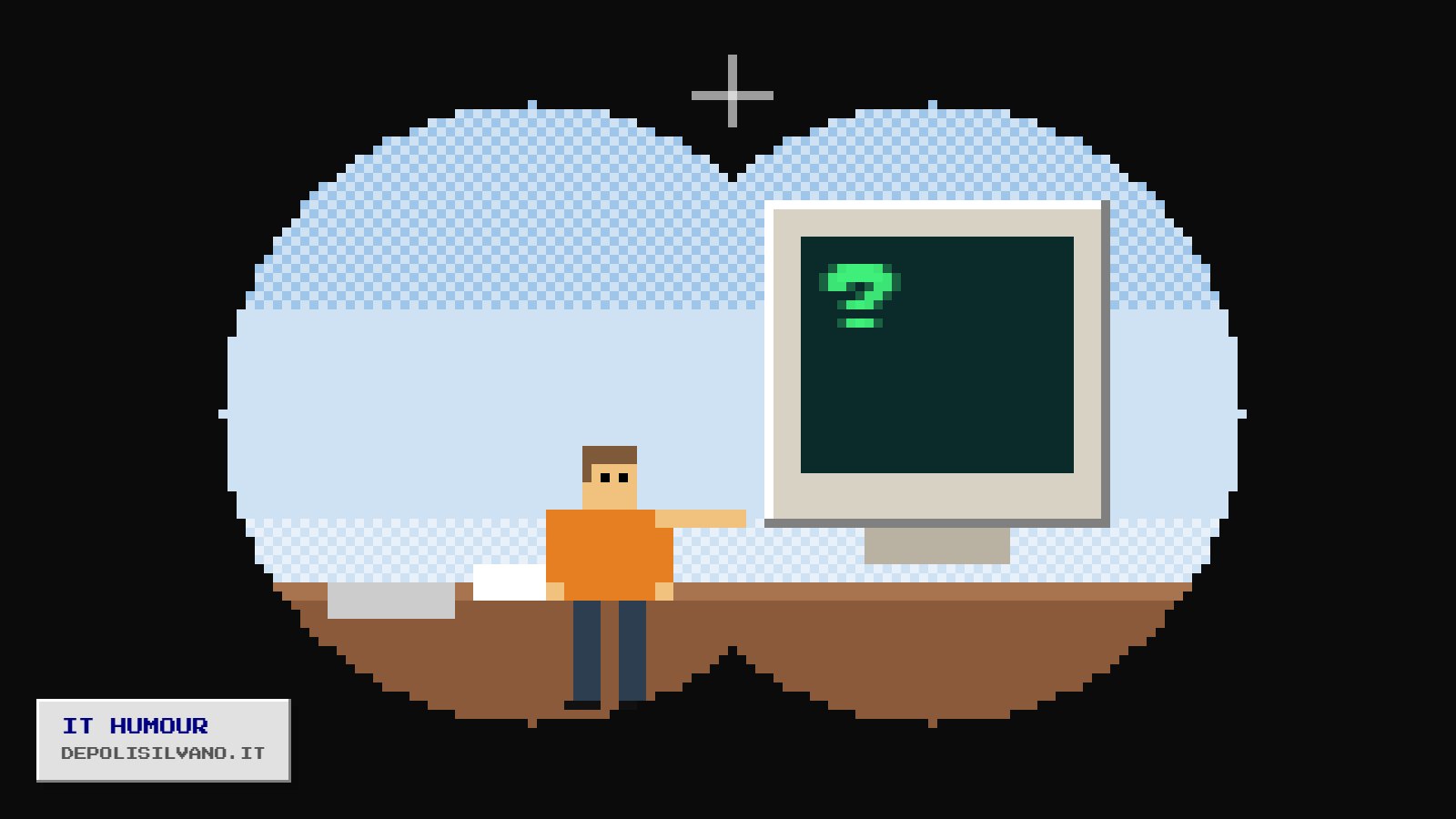
For years I have studied the end user in its natural habitat: the desk with the password post-it stuck to the monitor. It is a gentle, curious creature, convinced that the computer hates it personally. This is my field guide, compiled with the rigour of a naturalist and the patience of someone waiting for an update stuck at 99%.
Scientific preamble
The end user is so called because it arrives at the end of everything: after the engineer who designed the processor, after the programmer who wrote the software, after the technician who installed the lot. It arrives last, double-clicks where a single click was needed, and in four seconds discovers a defect that no testing had ever foreseen.
Let it be said straight away: the end user is not an enemy. It is a volunteer tester, unpaid, working tirelessly from home. Without it we technicians would just be people staring silently at a monitor. With it, instead, we are people staring silently at a monitor on the phone.
Also, a confession is due: each of us is the end user of something. I am the end user of the washing machine. Mine has a programme called "Mixed delicates eco plus" and for years I have been afraid to ask it what that means.
The main species
After long observation I have classified the most widespread species of the Po Valley, in northern Italy. Many are found elsewhere too, but here they thrive thanks to the fog, which hides the router's red lights.
- The Rebooter (Rebootus compulsivus). Believes in rebooting the way others believe in chicken soup. Reboots if the PC is slow, if it is fast, if it is windy. Once rebooted the router to start the dishwasher. The dishwasher started. Since that day nobody has been able to explain anything to him.
- The "I Didn't Touch Anything" User (Innocens perpetuus). The computer broke all by itself, while he happened to be standing next to it, by pure coincidence, screwdriver in hand. His conscience is clean and so is his browser history.
- The Expert Cousin User (Consanguineus informaticus). Never repairs anything personally: he consults the cousin. The cousin "did a course" in 2003 and has been issuing rulings ever since. Every job I do is submitted to the cousin for ratification, like an international treaty.
- The Printer (Typographus anxius). Prints everything. Emails, email confirmations, photos of the confirmations. Has a cloud folder called "IMPORTANT print". To him, the cloud is just a printer you can't see.
- The Hoarder (Desktopus saturatus). Has 1,400 icons on the desktop and knows every one by heart, the way a shepherd knows his sheep. Move one and he calls the police. He hasn't seen the wallpaper since 2011, but swears there's a sunset back there.
- The Cautious User (Cautus paranoicus). Covers the webcam with sticky tape, the USB port with sticky tape, the microphone with sticky tape. Then reads his card number over the phone to a very kind stranger who says he is calling "from Microsoft".
- The Futurist (Neophilus digitalis). Has discovered artificial intelligence and asks it everything: the risotto recipe, the knee diagnosis, the cat's name. The only thing he never asks it is how to take a screenshot. For that he rings me.
Natural habitats
The end user adapts to almost any environment, provided there is a power strip plugged into another power strip plugged, just to be safe, into a third power strip.
- The open-plan office. Here it lives in colonies. When one computer stops working, the others come out to look at it, like cows watching a train go by. Nobody touches anything. Everybody gives advice.
- The living room. The PC sits on the TV cabinet, under a crocheted doily that blocks the fan. "So it doesn't get dusty", they explained to me. And indeed it doesn't get dusty: it gets baked.
- The video call. A modern and treacherous habitat. The user speaks for seven minutes with the microphone muted, with the passion of an opera tenor. Then unmutes just in time to say "can you hear me?" to forty people who, from that moment on, can hear him perfectly.
- The family group chat on the smartphone. A fragile ecosystem where chain messages, good-morning greetings with glittery roses and eleven-minute voice notes circulate. A self-sufficient system: it receives no information from outside and still produces it in industrial quantities.
Rites and beliefs
Like every ancient people, end users have developed a religion. It has no temples, but plenty of dogmas, handed down orally in the office by the coffee machine.
- The rite of the double click. Everything must be clicked twice. Links too. The "Pay now" button too. Especially the "Pay now" button.
- The rite of the password. The password is sacred and therefore must be written everywhere: on the post-it, on the back of the keyboard, in the wallet, on the kitchen calendar next to auntie's birthday. It is always the same one, with the final number going up by one every ninety days. We are at "Kitty47". The cat, meanwhile, has turned eighteen.
- The rite of the postponed update. When Windows asks to update, the user clicks "Remind me tomorrow". He has been doing it for three years. Windows, which is patient but not stupid, eventually updates itself on a Monday at 8:58, just as the user is opening the presentation for the director.
- The rite of the shaken cable. If the internet isn't working, the user grabs the cable and wiggles it, like an angler checking the line. It does nothing. But sometimes the internet comes back, and the myth grows stronger.
- The cult of the cloud. Where are the files? "In the cloud". Where is the cloud? "On the internet". And where is the internet? Here the user raises his eyes to the sky. Not out of exasperation: because he truly believes it.
Typical phrases, with translation
The end user speaks a language all of its own, similar to English but with a different dictionary. After years of fieldwork I can offer a first glossary, with the technical translation alongside.
- "Nothing works." Translation: one single icon has moved two centimetres.
- "It did it all by itself." Translation: I clicked "Yes" on sixteen windows in a row without reading them, because they were all yellow and looked urgent.
- "My internet has disappeared." Translation: I closed the Chrome window. The internet lives inside Chrome. Chrome is the internet. I don't know what the blue icon on the desktop is, but I don't touch it because it belonged to the lad before me.
- "It's a really quick job." Translation: three hours, two car journeys and the recovery of an email account opened in 2006 with an address containing the word "panther".
- "While you're here…" Translation: the real request starts now. The one they called me for was just the trailer.
- "I asked the artificial intelligence and it says it's the motherboard." Translation: it wasn't the motherboard. It was the plug.
Reports from the front
Here are three exemplary episodes, told with the sobriety of a police report. No names, because, deep down, it could be any of us.
Episode one. A lady phones me because her mouse "won't go right any more". It goes left, it goes up, it goes down, but to the right it stops. I arrive, I observe, I reflect. The mouse worked perfectly: to the right there was the ficus pot. We moved the ficus. The ficus, I am told, is doing well.
Episode two. A gentleman asks me to transfer "the memory" from his old phone to the new one. I ask him which data he wants to keep. He means the actual memory: he wants the new phone to remember the things the old one knew, like the fact that on Tuesdays he goes to the market. I installed a calendar for him. He said it isn't the same thing. He was right.
Episode three. In an office the printer hasn't printed for a week. Meeting. Two hypotheses on the table: a virus, or sabotage by a former employee. They call me in as a consultant. I open the tray. No paper. The manager looks at me the way you look at a magician. I didn't tell him anything. A technician never reveals his tricks, especially when the trick is a ream of five hundred sheets.
The evolution of the species
Many believe the end user has stayed the same since the days of floppy disks. Not true: it has evolved. Once it asked where the "Any" key was when the computer said to press any key. Today it asks the voice assistant to find the key for it, and the voice assistant books it a plumber.
Before, it had one computer and didn't know how to use it. Now it has six: the PC, the laptop, the phone, the tablet, the watch and the smart TV. It can't use any of them, but in a synchronised way, across all devices, in real time. This is called progress.
And then there's AI. The end user talks to it with touching courtesy, says "please" and "thank you", asks if it has eaten. With me, on the other hand, after ten years, it still opens the call with "listen, is it normal that…". I don't take offence. I know it takes time to trust a human being.
How to survive: a short manual
For fellow technicians, and for anyone with a cousin who "knows about computers", here are the rules that have saved my day more than once.
- Never ask "have you tried turning it off and on again?". Ask instead: "Could you hold down the button and count to ten, out loud?". It's the same thing, but the user feels part of a scientific protocol.
- Always make a backup before touching anything. Not for the computer. For you, when they tell you the christening photos were right there and now they're gone.
- Never laugh during the phone call. Press mute, laugh, count to five, unmute. Check twice that you've unmuted. Then check a third time.
- Accept the coffee. The end user expresses gratitude with coffee, and refusing it is a diplomatic incident. My personal record is nine espressos in one morning, three offices and one printer. I saw the colours of the pixels.
- Remember where you came from. You too, one day, tried to plug in a USB stick on the third attempt, and on the third attempt it was the same way round as the first. We are all end users of something. What matters is having a good technician, and plenty of paper in the printer.
End of volume one. Volume two will come out as soon as the Rebooter stops switching off the server to see if it goes faster.
Loosely based on an old piece from the teneraerbetta.it archive