University legends: the transcript that flew from the third floor
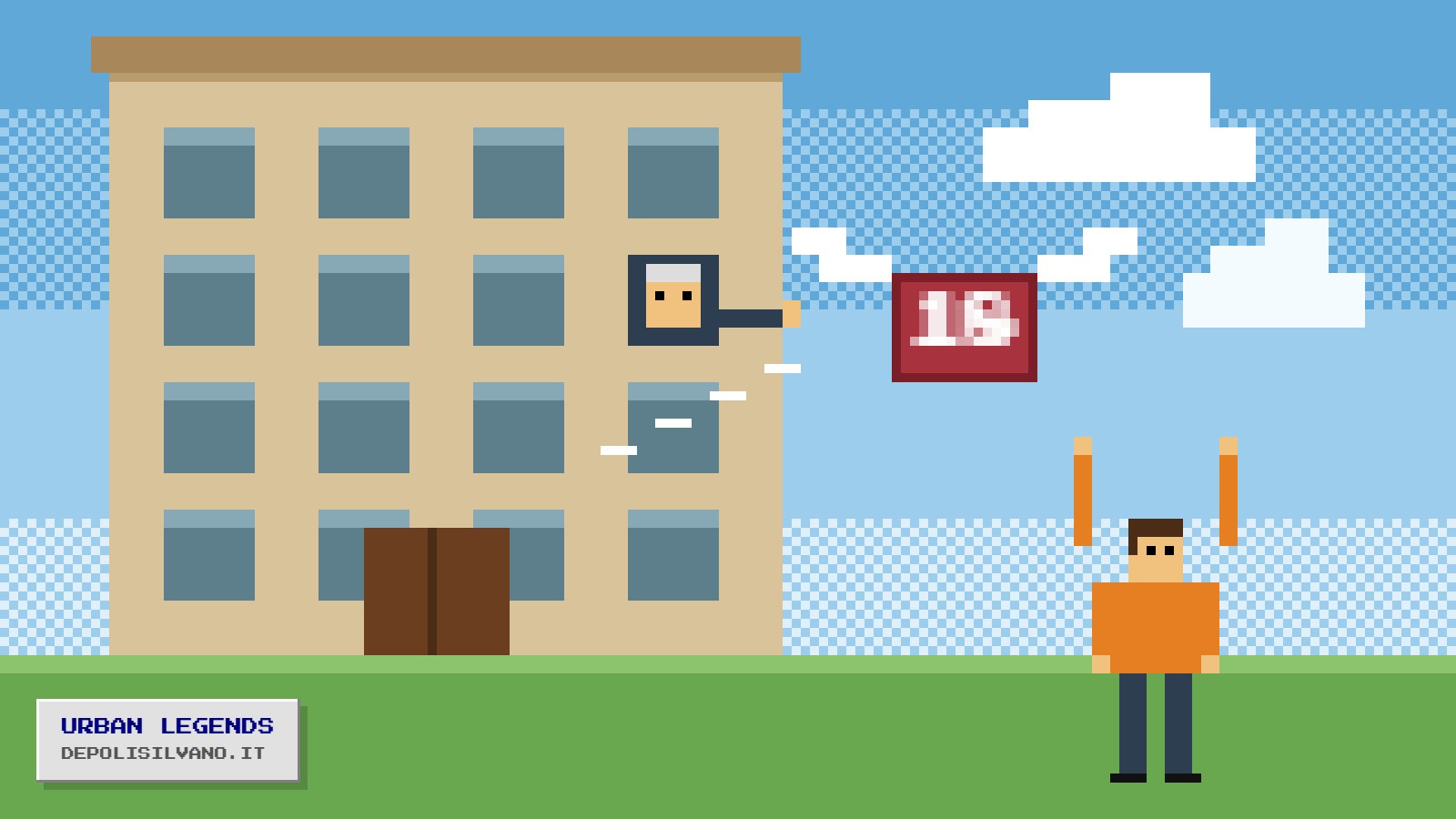
Every Italian university has a professor who threw a student's transcript book out of the window. Everybody knows it, a friend saw it, it was the third floor. The problem is that the same book apparently flew simultaneously in Catania, Padua, Turin and Bologna: either it is a book with the gift of bilocation, or it is a legend in multicast.
A perfect ecosystem
University is the ideal incubator for legends: every year new freshers arrive, with no antivirus and full of anxiety, and every year the older students upload the same stories again to the central server, also known as the faculty café. At the end of the Nineties many of these were collected in newsgroups devoted to urban legends, with a list of the cities where each one had definitely been seen. Very long lists. Which is exactly the proof that it had not happened anywhere in particular.
The flying pass
The queen of academic legends. (In Italy exams are marked out of thirty, and eighteen is the bare pass, recorded in a little booklet.) The student draws a blank and begs for mercy: “At least give me an eighteen, even a flying one.” The professor thinks about it, writes a nice eighteen in the booklet and then throws it out of the window. Flying, precisely.
There is a meteorological variant, the eighteen “in the garden”, and a casino variant: “Would you like a twenty-seven here or a thirty down in the street?” The student picks the thirty and goes to fetch it among the parked cars. It is a game show hosted by gravity. My father swore it happened every week in his day. His father swore it too. So did grandad. It is a legend with guaranteed backward compatibility.
The infinite line
Geometry exam. “Draw me a straight line.” The student reaches the edge of the blackboard and stops. “Carry on.” He carries on along the wall, out of the door and disappears. So far it is a punishment. But a few minutes later there is a knock at the opposite door: it is the student, who has gone round the whole building drawing the line, comes back in and closes it at the starting point. The professor, moved, passes him.
Technically it is an infinite loop that terminates successfully. Every programmer dreams of seeing one; nobody has ever managed it.
Do you know who I am?
Written exam, time is up. One student carries on writing calmly. The professor, furious, announces he will not accept his paper. The student walks up: “Do you know who I am?” The professor shouts that he does not know and does not care. “Perfect,” replies the student, and slips his paper into the middle of the pile.
It is the only documented case in which anonymity works better than two-factor authentication. Pure cybersecurity: if the system does not record who you are, it cannot reject you either.
The providential cleaners
During a written exam two young men walk in with a bucket and a mop: “Is this where someone was sick?” Laughter, confusion, they leave. Only later does it emerge that they were accomplices: they had just delivered the answers to a candidate. Witnesses described as utterly reliable, of course. In IT we call it a social engineering attack: nobody ever checks the credentials of someone holding a bucket.
Impossible questions and applied physics
- The columns of the portico. The professor asks how many there are. Those who do not know are failed for not attending. Those who have just counted them are failed for wasting time counting columns instead of studying. A double-fault control system, as elegant as an impossible captcha.
- The Carnot cycle. (In Italian “ciclo” also means bike.) “Draw me one. Now another next to it. Now join them with a line. Good: take your bicycle and go.”
- The motion of the keys. The professor throws a bunch of keys and asks what kind of motion it is. The student throws them back: “The same as this one.”
Why we believe them
These stories work because they turn the exam, the moment when we are most defenceless, into a duel in which the student sometimes wins. They are emotional patches: they do not fix the bug, but they make the system bearable. None has ever really been verified, and many clearly have the structure of a joke, with the perfect punchline. Real exam sessions, sadly, almost always end with a mundane “come back at the next session”. No flight included.
Loosely based on an old piece from the teneraerbetta.it archive