Exam legends: the professor, the barometer and a cousin's friend
Every university in Italy has its own exam legend, and every exam legend happened in Genoa, Pisa or Florence, always to a friend of a cousin. Nobody was there, everybody tells it the same way. It is the first peer-to-peer protocol in history: no central server, just freshers passing the file around in the canteen.
The corridor protocol
The exam legend has a fixed structure, like a pre-printed form. A strict professor. A student who is either unprepared or a genius. A punchline nobody would dare deliver in front of a real examining board. The mark, if there is one, is always 18 or 30 cum laude, the bare pass or the top mark: the middle ground generates no traffic.
My uncle swears he witnessed three of these scenes in the same exam session. My uncle studied bookkeeping. By correspondence.
The multipurpose barometer
The queen of legends: the student is asked how to measure the height of a building with a barometer. He answers in every possible way except the expected one. He lowers it on a string. He drops it and times the fall. He measures its shadow. Finally he gives it to the caretaker in exchange for the information.
It is an anecdote decades old, told in a thousand variants and sometimes pinned on famous scientists without any evidence. It remains an excellent lesson, though: that is exactly how users solve IT problems. They ask the caretaker. The caretaker is me.
The line that comes back
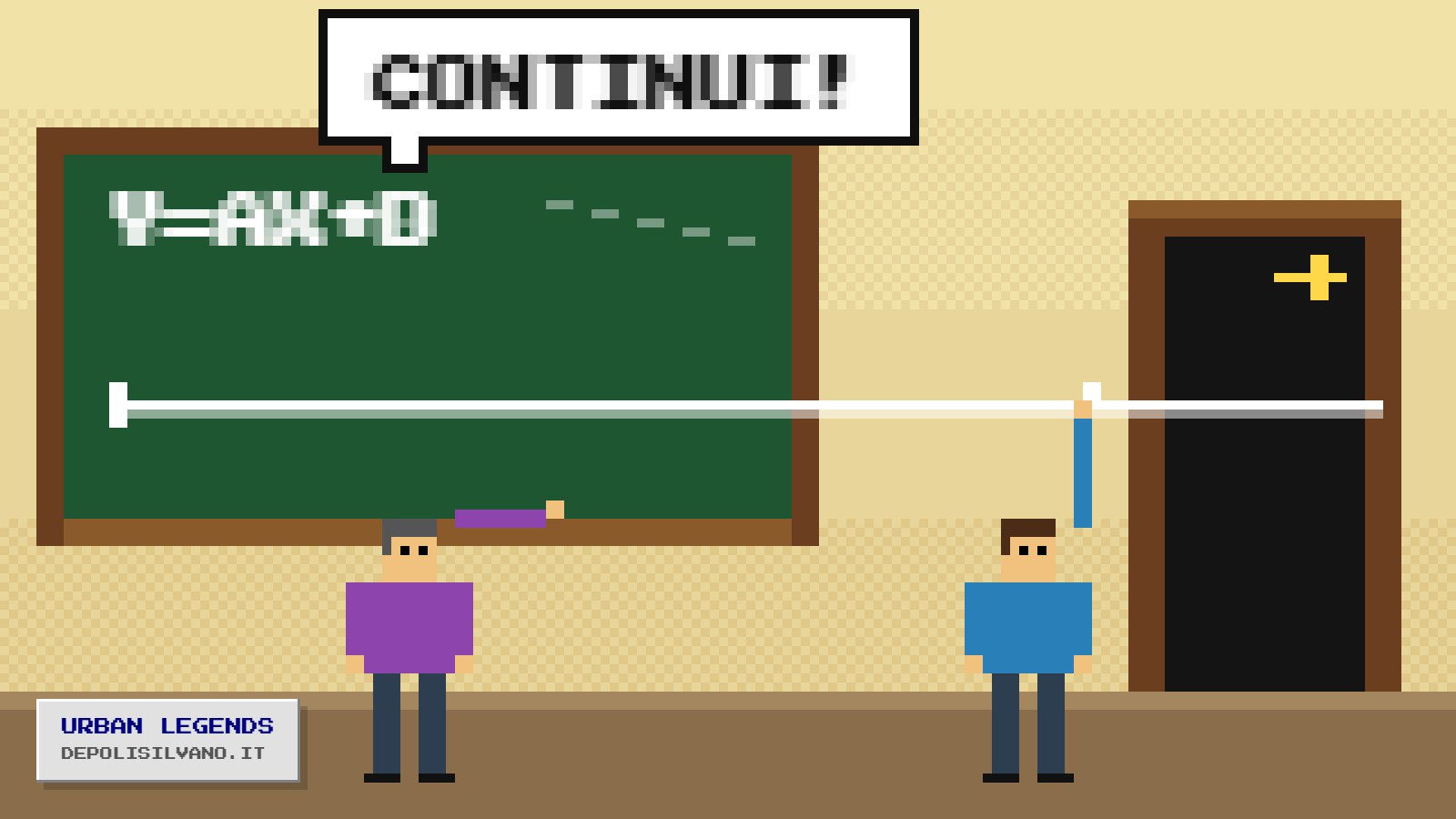
A lecturer asks for a straight line to be drawn. The blackboard runs out. “Carry on all the way home,” she says. In the deluxe variant the student walks out with the chalk, goes all the way round the circular building and comes back in through the other door, closing the circle.
Nobody has ever said which faculty had the circular floor plan. It is the classic detail without an SSL certificate: it sounds great, but there is no padlock.
Zeno and the corridor
In another version, the student refutes the paradox of motion by standing up and walking. The professor approves and asks him to keep refuting it: towards the door, down the corridor, all the way home. It is the same mechanism as the line, recycled for another degree course. Legends behave like code copied from an old project: only the variable names change.
The philosopher's keys
- Physics: the professor throws a bunch of keys and asks what kind of motion it is. The student throws them back: “The same as this one.”
- Philosophy: the professor asks the student to prove that the keys are his. The student makes to walk off with them. “Where are you going with my keys?” “There, they are yours.”
Two exams, a single bunch of keys. Probably always the same one, passed from faculty to faculty like the office USB stick that nobody remembers the owner of.
The portico columns
A lecturer asks how many columns the university portico has and fails anyone who does not know, because they evidently do not attend. The next student runs out to count them, answers correctly and is failed anyway, for wasting time counting columns instead of studying. It is the academic version of tech support: whatever you did, it was the wrong thing.
The shortest essay in the world
Title: “What is courage?” Answer: “This”, and the paper handed in almost blank. Or: “Why?”, answer “Why not?”. The mark swings between 1 and 10 depending on who is telling it, like the reviews of a printer.
Nobody has ever seen the original paper. On the other hand, everybody knows someone who really tried it. The mark, in that case, is not legendary: it is documented.
The bicycle and the epsilon
- Asked to draw the Carnot cycle, the student draws a circle. The professor has him draw another next to it, join the centres, and dismisses him: “Take your bicycle and go home.” (In Italian “ciclo” also means bike.)
- A student reads “let there be an arbitrarily small three” instead of epsilon, and discovers he has corrected the whole textbook in the wrong direction.
- At a civil service exam, the latecomer asks “Do you know who I am?”, and on hearing no, slips his paper in among the other hundred.
Antivirus in the lecture hall
What is true? Probably some quick-witted line really was said once, by someone. Then the file was copied, renamed and reshared until it became common property. The vulgar or malicious versions found in some collections we leave in the recycle bin: they are not funny, they are just spam.
My advice as a sysadmin is simple. If an exam story begins with “it really happened to a friend”, treat it like an attachment called invoice.pdf.exe. Read it by all means. But do not run it.
Loosely based on an old piece from the teneraerbetta.it archive