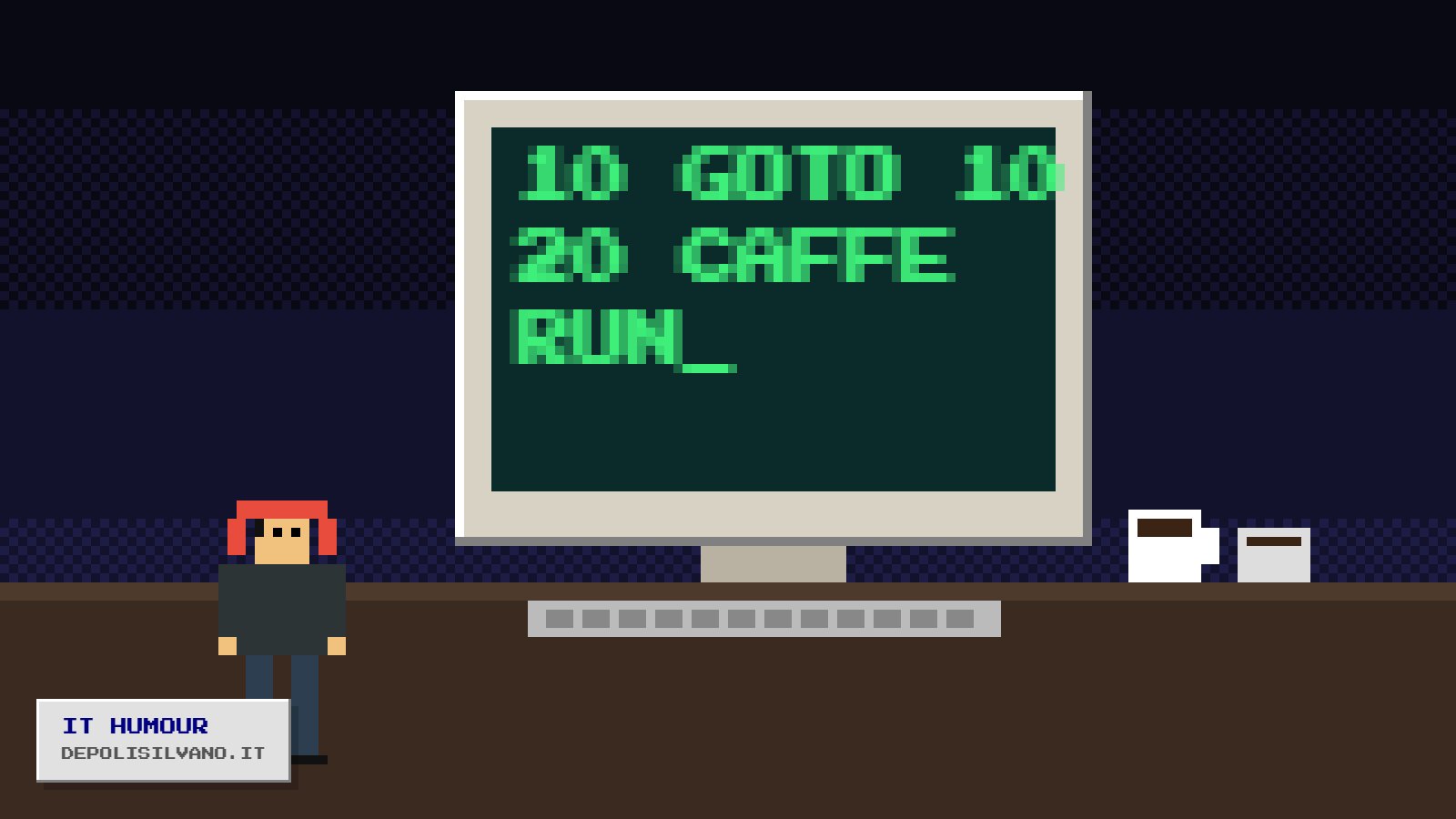
The Real Programmer is a protected species. Not by law: by the fact that nobody dares touch his code. This guide will help you identify him before it's too late, that is, before he retires and leaves you a management system written in a language that no longer even has a Wikipedia page.
Why a guide is needed
It used to be easy. Whoever talked to computers was a programmer; everyone else called the programmer. Today even the oven has a computer, the fridge suggests recipes and my cousin says he's a developer because he asked an AI to build him a website for his hens' eggs. The website works. The hens don't.
We must therefore distinguish the Real Programmer from the Tutorial Paster, a gentle creature that copies code off the internet and then defends it like its own child.
The language
The Real Programmer doesn't have a favourite language. He has a language he hates the least. He uses it for everything:
- for the website, for the management system and for the shopping list, which he compiles before leaving the house;
- for working out his change at the café, with exception handling for “one-penny coins”;
- for replying to birthday wishes, with a script that thanks everyone at 3:14 in the morning.
When a colleague proposes a new framework, the Real Programmer nods calmly. Then he waits six months for the framework to be abandoned by its own authors. He is always right, but he never says so. He puts it in the logs.
The tools
He has three monitors, one of them vertical, used exclusively to show that he has a vertical one. The mouse is there, but for historical reasons, like a suit of armour in a castle: nobody uses it, everybody respects it.
- The editor has been configured for eleven years and no other human being can open a file in it.
- The keyboard makes a noise the neighbours once mistook for a hailstorm.
- The terminal has green text on a black background, “because it helps him concentrate”.
His relationship with artificial intelligence is a mature one: he asks it for a function, reads it with suspicion, rewrites it from scratch and then says thank you. Out of politeness. You never know.
Documentation
The Real Programmer does not write comments. Code explains itself, he maintains, and indeed it does: it just speaks a dialect known in three households. The only comment in the entire project dates from 2014 and reads “don't touch, no idea why it works”. It is considered a company heritage asset.
He owns all the manuals, stacked under his monitor to raise it by four centimetres. He says it's ergonomics. In reality it's the only way documentation has ever been useful to him.
Deadlines
Give him five weeks for a project. In the first four he'll optimise the routine that generates the button colours, making it three milliseconds faster. In the fifth he'll write everything else in a single night, accompanied by a coffee that at some point stops being a drink and becomes an opinion.
The boss, meanwhile, ages ten years. The project ships on time. Nobody understands how, and the Real Programmer doesn't explain, because explaining would require a comment.
Habitat
You'll recognise him by his desk. On it, in geological order, you will find:
- coffee mugs from different eras, some containing life forms under evaluation;
- a cable whose purpose nobody remembers, but “if you unplug it something goes down”;
- an action figure of a generic robot watching him approvingly;
- a Post-it with a password on it, turned face down for security.
In his spare time
On a beach holiday he instantly spots the lifeguard managing the sunbeds with an Excel spreadsheet, and suffers in silence. At parties he stays near the router, where the signal is better and so is the conversation. During a power cut he remains impressively calm: he has an uninterruptible power supply for his mood as well.
Distinguishing marks
- He counts to ten starting from zero, which is why he always ends up at nine.
- He backs up the backup, ever since that time we don't talk about.
- He names his variables tmp, tmp2 and tmp_final_really, but demands rigour from everyone else.
- When something works first time, he gets worried.
If you think you've found one, don't disturb him and don't ask him questions. Leave a hot coffee next to his keyboard. In four weeks he'll drink it, and your project will be ready.
Loosely based on an old piece from the teneraerbetta.it archive